



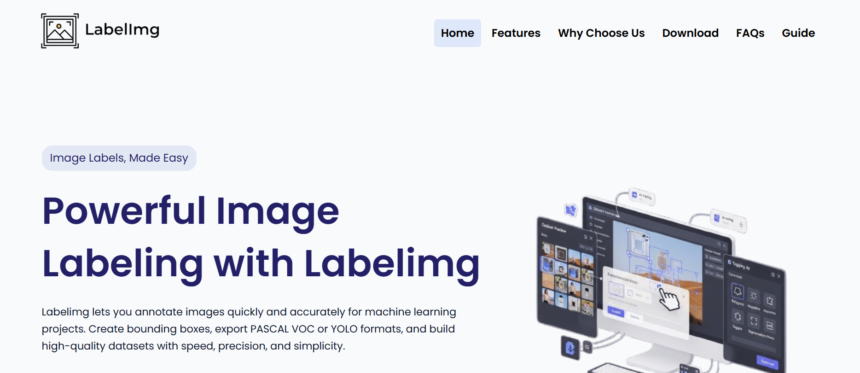
LabelImg has been one of the most popular image annotation tools in the computer vision industry for many years. It became widely known because of its simple interface, lightweight design, and support for object detection formats such as YOLO and Pascal VOC.
In 2026, many developers are asking whether LabelImg is still actively updated and relevant. Although the software remains functional and useful for basic annotation tasks, newer platforms now offer advanced features like AI-assisted labeling, cloud collaboration, and automation. This has created debates about whether LabelImg can still compete in the modern AI industry.
Why LabelImg Became So Popular
LabelImg became successful because it solved a very important problem in a simple way. Before tools like LabelImg became available, many annotation platforms were expensive, complicated, or difficult for beginners to use. LabelImg offered a free and open-source solution that anyone could install on their computer. The software allowed users to draw bounding boxes around objects and save annotations in popular machine learning formats.
Another major reason behind its popularity was its lightweight nature and simple interface. Unlike modern cloud-based tools, LabelImg did not require online accounts, subscriptions, or powerful hardware. Beginners could learn the software quickly and start annotating images within minutes, which is why many tutorials and online AI courses recommended it for learning object detection.
Is LabelImg Still Updated in 2026?
The answer is partly yes and partly no. LabelImg is still available, downloadable, and functional in 2026. Many developers continue using it successfully for annotation tasks. However, the pace of official development has slowed considerably compared to newer AI tools.
The original project no longer receives major feature updates frequently, which has raised concerns regarding long-term compatibility. Some users experience installation issues with modern Python versions because the software depends on older libraries. Even so, LabelImg still performs its core task effectively for basic object detection projects.
Strengths of LabelImg in 2026
Even though newer annotation tools exist, LabelImg still offers several important advantages. One of its biggest strengths is simplicity. Many modern annotation platforms include advanced features that may confuse beginners, while LabelImg keeps the workflow straightforward and easy to understand.
Another advantage is its offline functionality and lightweight performance. LabelImg runs smoothly on modest computers and does not require cloud services or subscriptions. Since it also supports YOLO annotation formats, it remains useful for many object detection projects in 2026.
Limitations of LabelImg
Although LabelImg still works well for basic annotation, it also has several weaknesses that become more noticeable in modern AI workflows. One major limitation is the absence of AI-assisted annotation, which modern platforms use to speed up dataset creation through automatic object detection.
LabelImg also lacks collaboration tools, segmentation support, and advanced annotation types required in many modern computer vision projects. Since development updates are slower than before, compatibility problems may also continue increasing as technology evolves.
Popular Alternatives to LabelImg
Several annotation platforms have become popular alternatives to LabelImg in recent years. Label Studio is one of the most advanced open-source annotation tools available today, supporting image, text, video, and audio annotation along with AI-assisted workflows.
CVAT and Roboflow are also widely used in professional AI projects because they offer collaboration features, cloud synchronization, and automation tools. Lightweight alternatives like LabelMe are preferred for segmentation tasks, while newer platforms now integrate directly with modern YOLO models for automatic annotation.
Should You Still Use LabelImg?
The decision depends on your needs and project size.
If you are a student, beginner, or hobby developer learning object detection, LabelImg can still be an excellent choice. It is simple, lightweight, and easy to understand. For small projects involving bounding boxes, it remains highly practical.
However, if you are working on large commercial AI systems, modern annotation platforms may be more suitable. Features like AI-assisted labeling, collaboration tools, cloud synchronization, and segmentation support can dramatically improve efficiency.
Future maintenance is another factor to consider. Tools with active developer communities generally offer better long-term reliability and compatibility.
Conclusion
LabelImg remains one of the most recognized annotation tools in the history of computer vision development. Its simplicity, offline functionality, and support for YOLO datasets made it extremely popular among AI developers worldwide.
In 2026, the software is still functional and useful for many small-scale projects and educational purposes. However, its development activity has slowed significantly, and it no longer competes directly with the advanced capabilities offered by modern annotation platforms.
Despite this, LabelImg still holds value for beginners and independent developers who need a lightweight and straightforward annotation tool. While it may no longer represent the cutting edge of AI annotation technology, it continues to serve as a reliable entry point into the world of computer vision and object detection.