



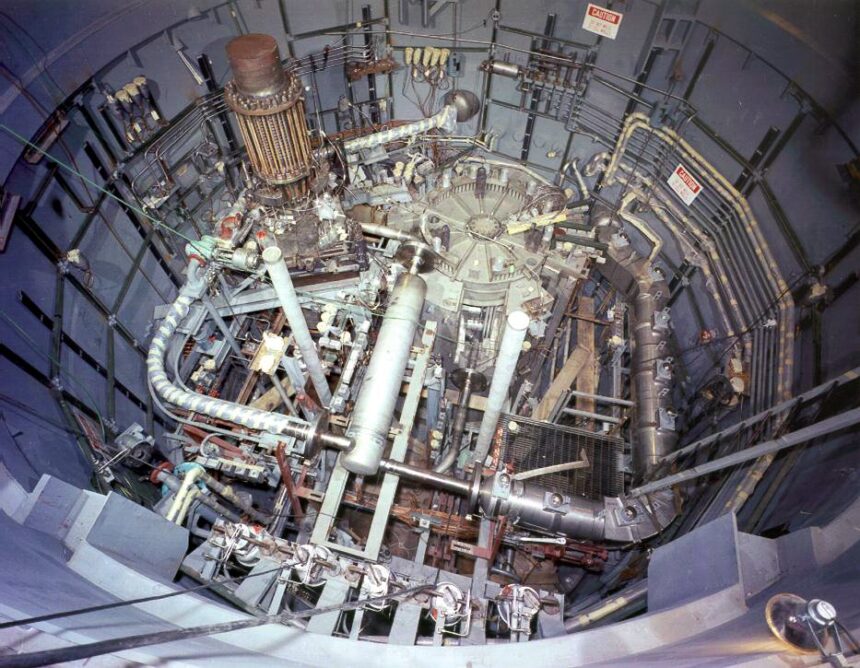
Most new reactor designs fail, if they fail, on materials long before they fail on physics. That is the unglamorous truth behind a new research programme from Dutch developer Thorizon and the applied research organisation TNO, who have launched a joint effort to study how molten salt corrodes the metals asked to contain it. The work is aimed squarely at the PIONEER demonstrator, Thorizon’s planned molten salt reactor, and at a question every regulator will ask first: what exactly happens to your pipes, pumps and heat exchangers after years of contact with hot, chemically aggressive salt?
For readers following the slow revival of nuclear energy, this is the kind of announcement that rarely makes headlines but quietly decides timelines. A reactor design can promise inherent safety and abundant fuel, yet none of it matters until the materials evidence exists. Thorizon and TNO are now setting out to produce that evidence, systematically, in the laboratory.
Why Molten Salt Is Different
Conventional reactors circulate water under enormous pressure. A molten salt reactor instead dissolves its fuel in a liquid salt that flows at near-atmospheric pressure, carrying heat out of the core in the same stream. The approach has real advantages: the coolant cannot boil away in the way water can, the system runs without a heavy pressure vessel, and the physics of the fuel itself tends to slow the reaction as temperatures rise.
The trade-off is chemistry. Fluoride and chloride salts at several hundred degrees are corrosive in ways that water is not, and they attack metals selectively, leaching out elements such as chromium from stainless alloys and weakening the structure from within. Engineers have known this since the pioneering experiments at Oak Ridge in the 1960s, which proved the concept worked and simultaneously identified corrosion as the problem that would define the technology’s future.
What the Thorizon and TNO Programme Will Test
The new programme focuses on exposing candidate materials to molten salt under controlled conditions and measuring precisely how they degrade. Samples are held in salt for extended periods, then examined for weight loss, surface attack and changes in mechanical strength. The goal is not a single pass-or-fail verdict but a body of data: which alloys resist, which coatings help, and how fast corrosion proceeds at the temperatures the PIONEER design intends to use.
That data serves two audiences at once. Internally, it guides Thorizon’s engineers towards materials they can defend. Externally, it forms part of the safety case that licensing authorities will scrutinise. Research organisations such as TNO in the Netherlands exist precisely for this kind of independent, methodical validation, and their involvement signals that the demonstrator project is moving from concept papers towards hardware decisions.
From Laboratory Coupons to a Working Demonstrator
Materials testing proceeds in stages, from small samples in static salt to flowing loops that mimic real coolant circuits. Flow matters, because moving salt erodes differently from still salt and because temperature gradients along a loop can drive corrosion in one place and deposition in another. Each stage is slower and more expensive than the last, which is why programmes like this one are started years before construction.
A Technology With a Long Memory
Molten salt is not a new idea chasing novelty. The concept was demonstrated more than half a century ago and then shelved, largely because the world’s nuclear industries standardised on water-cooled designs and because the materials questions were left unanswered rather than answered badly. What has changed is the context: grids now need firm, low-carbon power to complement wind and solar, and several countries are actively funding advanced reactor designs that their predecessors abandoned.
Global oversight and research coordination through bodies such as the International Atomic Energy Agency have also matured the field, with shared databases on salt chemistry and materials performance that the original pioneers never had. Today’s developers are, in effect, resuming an interrupted research programme with far better instruments.
Why Corrosion Data Decides Investment
Investors and governments have learned to ask harder questions of advanced nuclear start-ups. A persuasive simulation is no longer enough; funders want test results, and the scarcest results in molten salt development are long-duration corrosion results. A programme that starts now can deliver multi-year exposure data on a schedule that matches a demonstrator’s construction timetable, and that alignment is commercially valuable.
There is also a supply-chain dimension. If testing identifies a small number of suitable alloys, those materials must be available in quantity, weldable and certifiable. Early materials work therefore shapes procurement as much as it shapes design, and it can reveal cost problems while they are still cheap to fix.
The Standards Angle
There is a further, practical reason to begin with corrosion coupons rather than prototypes. Reactor licensing is built on standards, and standards are built on published, reproducible test methods. By structuring the work with an established research partner, the programme produces results that other laboratories can repeat and regulators can cite, turning private development data into evidence the whole sector can build on.
What Happens Next
The immediate output of the Thorizon and TNO work will be technical: corrosion rates, material rankings and recommendations for the PIONEER demonstrator’s hottest and most exposed components. Readers can follow further science and energy coverage at lindaikejinews.com as the programme publishes results and the demonstrator project advances towards its next milestones.
The broader significance is simpler. Advanced reactors will not be built on promises about physics alone; they will be built, or not built, on evidence about salt, steel and time. This programme is an attempt to produce exactly that evidence, and the molten salt field will be watching the numbers closely.